57
579/12/2026
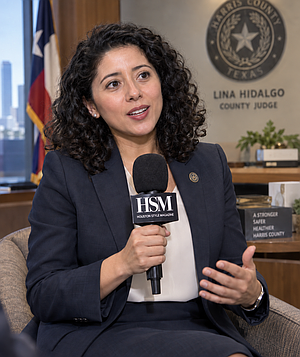
Democracy often gets its grandest moments at the ballot box, but its toughest tests can arrive later—in spreadsheets, tax bills, public-safety budgets and decisions about how much information government should collect about ordinary citizens.
In responses provided to Houston Style Magazine – Harris County Judge Lina Hidalgo addressed three issues now commanding public attention: Harris County’s FY2027 budget challenge, Law-enforcement compensation and the expanding use of Flock cameras and Automated License Plate Readers, or ALPRs.
The questions initially referenced an approximately $189 million budget shortfall, a figure used during the evolving budget debate. Harris County’s September 8 FY2027 proposed budget subsequently put the projected gap at about $181 million, reflecting updated estimates for healthcare and jail-related expenses. County budget officials identify multiple pressures, including employee healthcare, jail costs, indigent defense, law-enforcement compensation, contract patrol expenses, reduced federal funding and state mandates.
Review Harris County FY2027 Budget Documents
Budget: “We Created This Structural Deficit Ourselves”
Asked how Harris County reached its current financial position, Hidalgo did not soften her assessment, telling HSM, “By and large, we created this structural deficit ourselves.”
She acknowledged that inflation and state-imposed revenue limitations contribute to the pressure, but argued that spending decisions by Commissioners Court are also central to the problem. “Since 2023, we have approved spending time and time again, knowing that there was no revenue source to pay for that spending,” Hidalgo said.
Her office points to $141.9 million in selected spending decisions as evidence for that argument. The document includes items involving prosecutors, detention operations, staffing, technology and law-enforcement compensation and records Hidalgo’s position on the individual votes.
That $141.9 million compilation represents Hidalgo’s framing of the spending debate; the County’s official budget documents describe the deficit as the product of several overlapping costs rather than one category alone.
Hidalgo’s larger argument is about recurring expenses meeting recurring revenue. She told HSM that the county cannot continue adding programs without knowing how it will finance them in future years, saying, “Until we build a healthy, sustainable budget, it’s not right for taxpayers to pay a higher tax rate.”
That debate became more concrete September 8 when Commissioners Court voted 3-2 to approve a combined tax rate of roughly 67 cents per $100 of taxable value. Commissioners Rodney Ellis, Adrian Garcia and Lesley Briones supported the rate; Hidalgo and Commissioner Tom Ramsey opposed it.
Asked how she would reduce the deficit while protecting services, Hidalgo described the challenge as “a both and.” She said, “We need great police. But we also need mental health. We need programs against homelessness. We need the hospital,” while noting county responsibilities ranging from roads and bridges to elections.

Her proposed efficiencies include consolidating human-resources operations, restructuring engineering and general services, reviewing countywide park maintenance and purchasing, pursuing additional grants and nonprofit resources, and exploring consolidation of certain services with the City of Houston.
Or, translated from government-speak: before asking taxpayers to reach deeper into their pockets, Hidalgo says government should first check its own couch cushions.
Law Enforcement: Fair Pay—and a Sustainable Way to Fund It
On police compensation, Hidalgo emphasized that her disagreement is not with paying officers competitively.
“I believe officers should be paid fairly,” she told HSM.
The dispute is over financing.
Harris County has committed substantial resources to bringing Sheriff’s Office and Constable compensation closer to Houston Police Department levels. The FY2027 budget continues those pay-parity commitments, while growing personnel costs remain one of the County’s major fiscal pressures.
Hidalgo said she would have preferred putting a long-term funding proposal directly before voters. “I would have let the voters decide by holding a bond election,” she said, contending that voter approval could have established a sustainable revenue stream rather than leaving Commissioners Court to later choose between taxes and service reductions.
The debate became especially visible with compensation for Harris County’s eight elected constables. In August, Commissioners Court approved salaries of at least $305,000 through 2030, along with back-pay settlements. Hidalgo was the lone vote against the August back-pay and raise action, according to recent reporting.
“When I saw the proposal to raise elected constables’ salaries to $305,000,” Hidalgo told HSM, “I had the same instinct the people of Harris County have had: This doesn’t make sense, on many levels.”
Her concern, she said, is that large recurring raises without dedicated funding can force taxpayers into future choices that were never directly presented to them.
Flock Cameras: “Help Save Lives and Solve Crimes”—But Who Watches the Watchers?
The third issue moves Harris County squarely into the digital-age debate over public safety and personal privacy.
Commissioners Court approved a renewal with Flock Group, Inc. for license-plate-reader and sound-detection technology covering June 6, 2026 through June 5, 2027. The official May 28 agenda record lists the renewal at $868,975. A July amendment clarified that the agreement could be used countywide at no additional cost.
Read the Official Harris County Flock Renewal Record
Hidalgo is not dismissing the crime-fighting benefits. She told HSM, “I agree that ALPRs help save lives and solve crimes. At the same time, I share the privacy concerns and believe we must urgently implement proper governance.”
Her concern centers on transparency: How many cameras operate in Harris County? Which agencies administer them? Who can search the data? Who actually has searched it—and under what rules?
Hidalgo has publicly called for a special Commissioners Court discussion devoted to those questions and acknowledged that the May renewal went forward without the privacy safeguards she believes should accompany the technology.
Read Judge Hidalgo’s Statement on Flock Cameras
“Residents deserve clarity” before the debate even reaches final safeguards, Hidalgo told HSM. She said she would also like to see a citizens’ committee participate in continuing oversight after new rules are established.
Taken together, the budget, law-enforcement and Flock debates ask Harris County residents three remarkably simple questions beneath some remarkably complicated government paperwork: What should government spend? How should it pay for it? And how much power should government possess in the name of keeping people safe?
Those questions belong not merely to one county judge or five members of Commissioners Court.
They belong to the public.
And that may be democracy’s most enduring assignment: follow the money, question the decisions, demand the facts—and participate.