
 57
10/27/2026
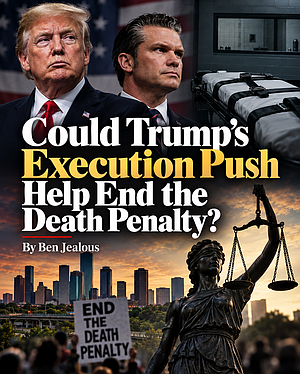
Could President Donald Trump’s push for more executions—and Defense Secretary Pete Hegseth’s plan to livestream one—help accelerate efforts to abolish the death penalty in America? After a tumultuous October, the question deserves a closer look.
The case is particularly close to home for Texans. Nidal Malik Hasan, convicted of killing 13 people at Fort Hood in 2009, is scheduled for a military firing-squad execution on December 3, 2026. Hegseth wanted Americans to watch it online. Lawmakers from both parties objected.
North Carolina Republican Sen. Thom Tillis called the proposal “beyond disgusting” and compared public executions to practices of oppressive dictatorships. Utah Republican Sen. John Curtis warned that “a civilization erodes” when executions become entertainment.
An ABC News–Washington Post–Ipsos poll found 80% of Americans opposed livestreaming Hasan’s execution, including 64% of Republicans. On October 15, Trump canceled the broadcast. The execution itself remains scheduled.
When Conservatives Question State Power
Opposing a broadcast is not the same as opposing capital punishment. That same poll found 53% of Americans supported Hasan’s execution by firing squad. Yet other Republican leaders are reconsidering the state’s power to take a life.
On October 20, Alabama Gov. Kay Ivey commuted Toforest Johnson’s death sentence to life without parole. Convicted of murdering sheriff’s deputy William Hardy, Johnson has maintained his innocence. His conviction stands, and Ivey did not declare him innocent. She questioned whether the direct evidence was sufficient to justify execution—a punishment that leaves no room to correct a mistake.
Ohio Gov. Mike DeWine helped revive his state’s death penalty law in 1981. This June, after decades as a prosecutor, lawmaker and governor, he called for abolition. “The moral justification I had,” DeWine said, “no longer exists.” He argued that capital punishment does not deter murder and described the prolonged toll on victims’ families. Bipartisan repeal legislation faces opposition.
These are not identical positions. They nevertheless pose a shared question: How can Americans distrust government with ordinary powers, yet trust it never to make a fatal mistake?
Why Texas and Harris County Matter
For Houston readers, this debate is anything but abstract. Texas has executed more people than any other state since modern executions resumed. Harris County alone accounts for 136 executions—more than any other state except Texas itself, according to the Death Penalty Information Center. Victims’ families, defendants, jurors and entire communities live with the consequences.
Fifty Years After Gregg v. Georgia
In 1976, Gregg v. Georgia allowed executions to resume under revised death penalty laws. But the Eighth Amendment still prohibits cruel and unusual punishment. In Atkins v. Virginia and Roper v. Simmons, the Supreme Court limited capital punishment by considering America’s “evolving standards of decency.”
Today, 23 states have abolished the death penalty. Another 10 retain it but have gone at least a decade without an execution. That makes 33 states where executions have ended in law or been absent for at least 10 years. Three more abolition states would create a numerical majority, though the Constitution establishes no automatic 26-state test.
Execution methods raise questions, too. Tennessee’s September attempt to execute Christa Pike by lethal injection failed; she survived. Republican Gov. Bill Lee ordered an independent review and halted the state’s remaining scheduled executions for 2026.
September also marked 15 years since Georgia executed Troy Davis. I stood outside that prison. Seven of nine key witnesses had recanted or changed their accounts. William Sessions, who led the FBI under Presidents Reagan and George H.W. Bush, urged Georgia to stop. It did not.
I helped lead Maryland’s successful abolition campaign in 2013. I learned that the cause can unite people who disagree on almost everything else: believers in redemption, skeptics of government power and citizens determined not to risk an irreversible injustice. Virginia followed in 2021, becoming the first former Confederate state to end capital punishment.
None of this guarantees abolition. Executions continue, and supporters argue that capital punishment can deliver justice for victims of heinous crimes. Still, this October raised questions that political labels cannot neatly contain.
Trump and Hegseth sought to demonstrate the severity of punishment. They may instead have encouraged more Americans to examine what government killing means. Fifty years after Gregg, that examination matters more than ever.
Ben Jealous is a professor of practice at the University of Pennsylvania and former national president and CEO of the NAACP. He also served as the founding director of Amnesty International USA’s domestic human rights program.