
 57
11/24/2026
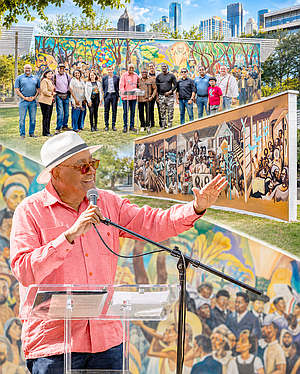
HOUSTON — Some conversations require a microphone; others demand an entire wall. On Sunday, November 22, 2026, Harris County Commissioner Rodney Ellis unveiled four monumental mural reproductions at El Franco Lee Jury Plaza, transforming downtown Houston’s civic landscape into an open-air celebration of history, cultural identity and the enduring pursuit of equality.
Titled “The Rivera–Biggers Dialogue,” the installation brings together the artistic legacies of Houston’s beloved Dr. John Biggers and internationally celebrated Mexican muralist Diego Rivera. Curated by Street Art for Mankind (SAM), the project presents four historic masterworks in a shared public setting for the first time, according to the unveiling announcement.
“The stories we choose to preserve say a great deal about the kind of community we want to be,” Ellis said. “I want every person who walks through this plaza to see a piece of their own history—and to recognize the generations whose lives and struggles helped shape the world we share.”
For Houston, the celebration carries particular historical significance. Biggers established the art department at what is now Texas Southern University in 1949, nurturing generations of artists while documenting African American life, resilience and cultural traditions. Rivera, meanwhile, helped redefine Mexican muralism through ambitious works that placed everyday people, laborers and collective history at the center of monumental art.
Although the two master’s never met, their creative philosophies intersected in their belief that art could illuminate injustice, celebrate working people and stimulate social change.
The Houston installation features Biggers’s History of the International Longshoremen’s Local 872 (1957), reproduced by Bimbo Adenugba, and A History of Education in Morris County (1955), reproduced by Ade Odunfa. The longshoremen mural pays tribute to Black dockworkers whose contributions helped build the Port of Houston despite racial segregation.
Mexican artist Carlos Alberto recreated Rivera’s Dream of a Sunday Afternoon in Alameda Central Park (1947) and Pan American Unity (1940). Alberto’s artistic lineage adds another dimension: his mentor, Eliseo Mijangos, helped restore the Alameda Central masterpiece following Mexico City’s devastating 1985 earthquake.
SAM co-founders Audrey and Thibault Decker emphasized the enduring relevance of the works, while French Consul General Frank Marchetti applauded Houston’s expanding public art landscape. The installation also reflects collaboration among labor organizations, educational institutions, artistic custodians and international rights holders.
Its location is equally meaningful. The plaza honors the late Commissioner El Franco Lee, who broke barriers as the first African American member of Harris County Commissioners Court, serving Precinct One from 1985 until his death in 2016.
For a city whose African American and Mexican communities have profoundly shaped its identity, the murals offer more than visual spectacle. They create an accessible classroom without walls, inviting families, students, visitors and prospective jurors to reflect on the connections between citizenship, cultural memory and justice.
Houston Style Magazine celebrates this investment in shared heritage. Commissioner Ellis and Street Art for Mankind have demonstrated that preserving history need not mean placing it behind glass. Sometimes, the most powerful museum is the city itself—and Houston has just opened four remarkable windows into its collective soul.
Explore the project partners at:
www.hcp1.net and www.streetartmankind.org.