
 57
576/1/2026
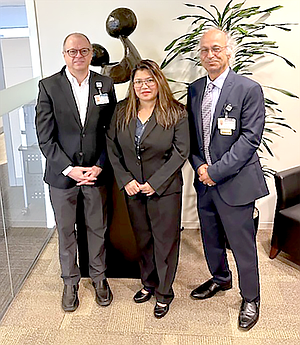
HOUSTON — In a city that knows how to fight through storms, Harris Health is earning national recognition for helping patients weather one of America’s most heartbreaking public health crises: opioid and substance use addiction.
With five national sites participating in a clinical study designed to improve substance use disorder treatment in primary care, the National Institutes of Health recently commended Harris Health for successfully recruiting nearly one-third of the study’s 300 participants. Harris Health enrolled 87 participants in the study led by the National Institute on Drug Abuse, a division of NIH, while also receiving praise for its outpatient treatment program as a model for helping patients battling opioid and stimulant addiction.
That is not just impressive paperwork. That is Houston-style public health leadership—where compassion puts on comfortable shoes, walks into clinics, reaches out to shelters, makes phone calls, prints flyers, listens without judgment, and helps people find a path back to themselves.
“Harris Health shares a vision to provide patients with the most effective care available,” said Matthew Schlueter, PhD, RN, chief nursing officer for Ambulatory Care Services at Harris Health. “Having our patients included in the national benchmarking research will only help all communities around the country.”
The timing could not be more urgent. The opioid crisis remains a national emergency, even as recent data finally show signs of progress. CDC data show U.S. drug overdose deaths fell to 79,384 in 2024, with 54,045 involving opioids. The CDC also reported that overdose deaths involving synthetic opioids other than methadone dropped sharply from 2023 to 2024.
For Harris County families, those numbers are more than statistics. They are empty chairs at dinner tables, parents praying late into the night, children waiting for a loved one to come home whole, and communities asking healthcare systems to do more than diagnose. They are asking them to heal.
Harris Health’s Office Based Addiction Treatment program—known as OBAT—is answering that call with a practical, patient-centered model rooted in primary care. Under the leadership of Jennifer LaHue, MBA, RN, project manager, site principal investigator and director of OBAT, the team has recruited participants through physician and staff referrals, word-of-mouth, in-person outreach, virtual connections, community events, shelters, flyers and information booths.
“We are meeting people where they are and making it easy for them to connect to services and treatment that can help them overcome their substance abuse disorders,” LaHue said.
That sentence deserves to be framed in every clinic lobby in America.
Because the future of addiction care is not about forcing patients to navigate a maze while carrying trauma, withdrawal, shame and fear on their backs. It is about building doors where walls used to be.
The NIH HEAL Initiative, launched to accelerate scientific solutions to the opioid and pain public health crises, continues to support research aimed at improving prevention and treatment strategies for opioid misuse and addiction. NIDA leads HEAL research connected to opioid use disorder and overdose, making Harris Health’s successful participation part of a much larger national movement to make recovery more accessible and evidence-based.
In other words, recovery is not a solo act. It is a choir.
One anonymous OBAT participant shared that when they started, they were struggling with cocaine, alcohol and opioids. After their first visit, they received appointments, medications and support. They later found work, improved their health and began managing life again as a productive member of society.
That is the kind of success story Houston understands. Not polished. Not perfect. But powerful.
Mohammad Zare, MD, medical director of OBAT, assistant chief of staff for Ambulatory Care Services at Harris Health, and professor and vice chair of Family Medicine at UTHealth Houston, credits the program’s success to a holistic team approach.
“Patients are the center of our focus,” Dr. Zare said. “They come to us needing help to overcome their addictions and we’re here to help them in the process.”
For Houston Style Magazine readers, this recognition is not merely a healthcare headline. It is a community headline. Harris Health’s work reminds us that safety-net medicine is not second-class care. At its best, it is frontline innovation—delivered in real neighborhoods, to real families, with real consequences.
As Harris Health celebrates 60 years of service to Houston and Harris County, its NIH commendation offers a timely reminder: public healthcare, when fueled by science, dignity and determination, can become a bridge from crisis to recovery.
And in Houston, we know a thing or two about building bridges.